
This piece will examine the ways in which pagan and Christian cosmologies differ, specifically those reflected in burial practices, in their archaeological expressions during the Viking Age. This will be undertaken using two case studies, specifically the burials of old Norse sorceresses to illustrate the points made. This paper will follow the burials of these sorceresses, their roles within society and their ‘magical’ abilities as well as the artefacts buried with them (in some cases, slaves). Following this, a transition will be explained through the burials of Scandinavian burials through the use of grave goods and ritual behaviour as a source information for the archaeological explanations, the paper will use examples of grave goods and ritual behaviour to describe their progression from pagan cosmology into Christian cosmology. Lastly, the paper will compare and contrast the studies and state the differences between pagan and Christian cosmologies of the Viking age. The assumption of the essay is that pagan and Christian cosmology has an evident progression which is shown in the burials, grave goods and ritualistic practices of the period.
Within this particular essay, the focus is on primarily grave goods and burials of Scandinavian women/sorceresses; these however, do not directly state what the pagan and Christian cosmologies are or how they differ. As such, this paper will give a short and concise introduction.
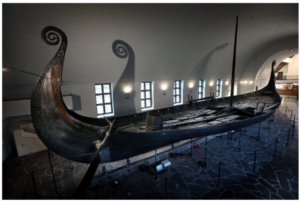
The identification of these graves as those of Norse sorceresses is based on a handful of key objects of the trade, primarily that of the precedence of a staff, psychedelic substances, cult objects, and in some cases sacrifices. These women, also called the ‘völva’ – which translates to staff-bearer – are specifically known to use their sorcery as a means, method and mechanism to influence and compel the ‘others’ (Price, 2020, 211, 224). Alongside this, imagery of Freya and Odin within grave goods, such as in jewellery or tapestries are mentioned in relation to these women due to their intertwinement with magic. The staffs and substances these sorceresses would use are also documented within Christian missionary reports, Arabic merchant texts, and pictured within tapestries at the Osenburg ship burial (Price, 2020). There is no specific look or way to classify these graves as certainly belonging to a völva, however, the co-occurence of these grave goods and female inhumations does show a correlation.
For the full essay, access bellow!