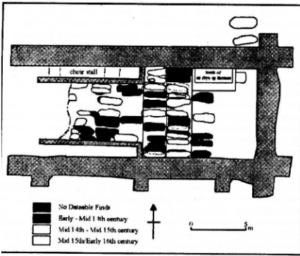
An evaluation of mortuary monuments, most significantly at the Sandwell Priory in the West Midlands, Carmarthen Greyfriars in South-West Wales and the Bordesley Abbey in Worcestershire (Williams, 2003, 229) will be followed by a comparison to earlier medieval burials of Anglo-Saxons whose burials signify and represent the deceased’s status and social position as a material form once dead. However, these ‘roles’ of the dead can be re-evaluated between differing deceased individuals, and therefore the dead can in turn be placed within separate social scales to better understand historical deaths. This use of analytics can help archaeologists create a theoretical scaffolding of the society analysed, thereby able to be inserted within greater subjections (Pearson, 1982). By studying the funerary rites of past civilisations, archaeologists can infer how memories were kept in cultures distinctly different from today, providing us with crucial ways of observing the past.
This piece critically evaluates the role of memory and forgetting within the funerary rites of two differing cultures across the medieval period. The paper will follow a format of example, evidence, theory and critical evaluation with the concluding chapter, linking the theories to the rest of the text. The particular focus of this essay will be the funerary rites of medieval religious graves, particularly the geographical placement and positioning of inhumations in relation to ‘important’ structures such as churches or ‘ancient’ monuments (not limited to Christian ideas of holy or religious monuments) and why; as well as how these funerals rites reflect the society of the time as well as emotional responses as theorised by the anthropological, archaeological likes of Stutz (2013) and Tarlow (1999).
Funeral rites are activities and rituals that people of the living world undertake to help themselves and or which people believe helps the spirit of the dead (however spirit is defined or referred to) or other pass on to the next stage (Gilchrist, 2008, 149). This is in addition to helping survivors and peers with processing grief and change, can help archaeologists in gathering insight into the community members of the deceased. This is remarkably important for the material culture of current society, archeologists in aiding the remembrance in the present, remember who the living were.
For the full essay, see bellow!