
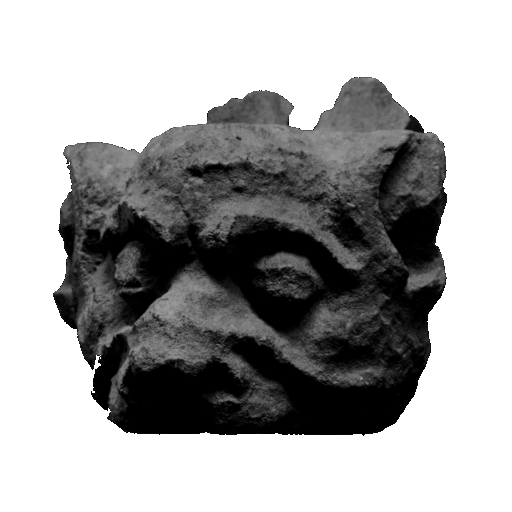
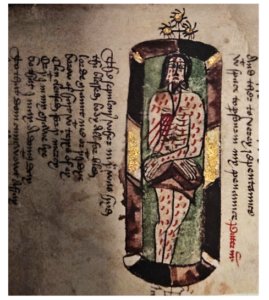
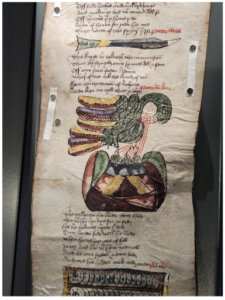
“This paper develops an understanding of how meaning emerges through social action with artefacts, a mutual process of creating value between people and things. When considering the scroll within figure 2, the Arma Christi illuminated scroll, archeologists can discover the significance, connections and meanings, despite the ‘static’ state the scroll has lived in. The creation, use and discovery gives meaning to this object, the ‘what if’ the unanswered questions, who made it, all relating to its place of discovery within the Bar Convent of York. To further the biography of this object, the Convent held a religious mass based on the scroll, a recording of which can be accessed online, therefore adding an accumulated value. Those who have encountered the scrolls in person, culminating the addition of spectacle, added upon this historical object is carried for the rest of its life.”
Archeology, at its core, is the loyalty and obligation to things, taking their materiality and object-hood seriously. A mediation of the tangible past and present where caring about things is further than the practical, it is caring for the impact they had on humanity and sequentially, humanity’s impact on things (Olsen, B. Shanks, M. Webmoor, T. Witmore, C. 2012, 4, 3, 2). It is a commitment, a fidelity to materials, that archaeology delivers messages whether analytical, critical and/or speculative which relates to the core of the human condition (Olsen, B. Shanks, M. Webmoor, T. Witmore, C. 2012, 4, 3, 2).
This paper will proceed to consider and evaluate the main contributions of material culture theory, specifically highlighting the contributions of theory in areas of production and consumption to understanding the archaeological record. To achieve this, the paper will give a short introduction to material culture theory followed by an in-depth consideration of object biography and entanglement theory applied to an illuminated medieval scroll, concentrating on the area of production and consumption.
Material culture theory focuses on theories that surround material objects or things and their ‘culture’. The lives of these materials reflect the hands of the creator, the viewer and the moulder. To understand the archeological record, theories are used to develop ideas about the past. Theorising on the material culture of the past developed rapidly during and onwards from the 1920s with theorists such as Gordon Childe, Lewis Binford and importantly for this paper, Ian Hodder. Since then, each theory after has expanded upon, redeveloped, or, in some way completely argued against previous theories, such as the processualists and post-procesualists, or later the humanists and post-humanists.
For the PDF to this essay please see below: